What Exactly Is a Virtual CIO?
A Virtual CIO (vCIO) is a senior IT strategist who works with your business on a part-time or outsourced basis, providing the same strategic technology leadership that a full-time Chief Information Officer delivers, without the six-figure salary. For small and mid-size businesses across Australia, hiring a full-time CIO is rarely practical. The role commands $200,000 to $350,000 per year in salary alone, plus superannuation and benefits. A virtual CIO service gives you access to that same level of expertise at a fraction of the cost.
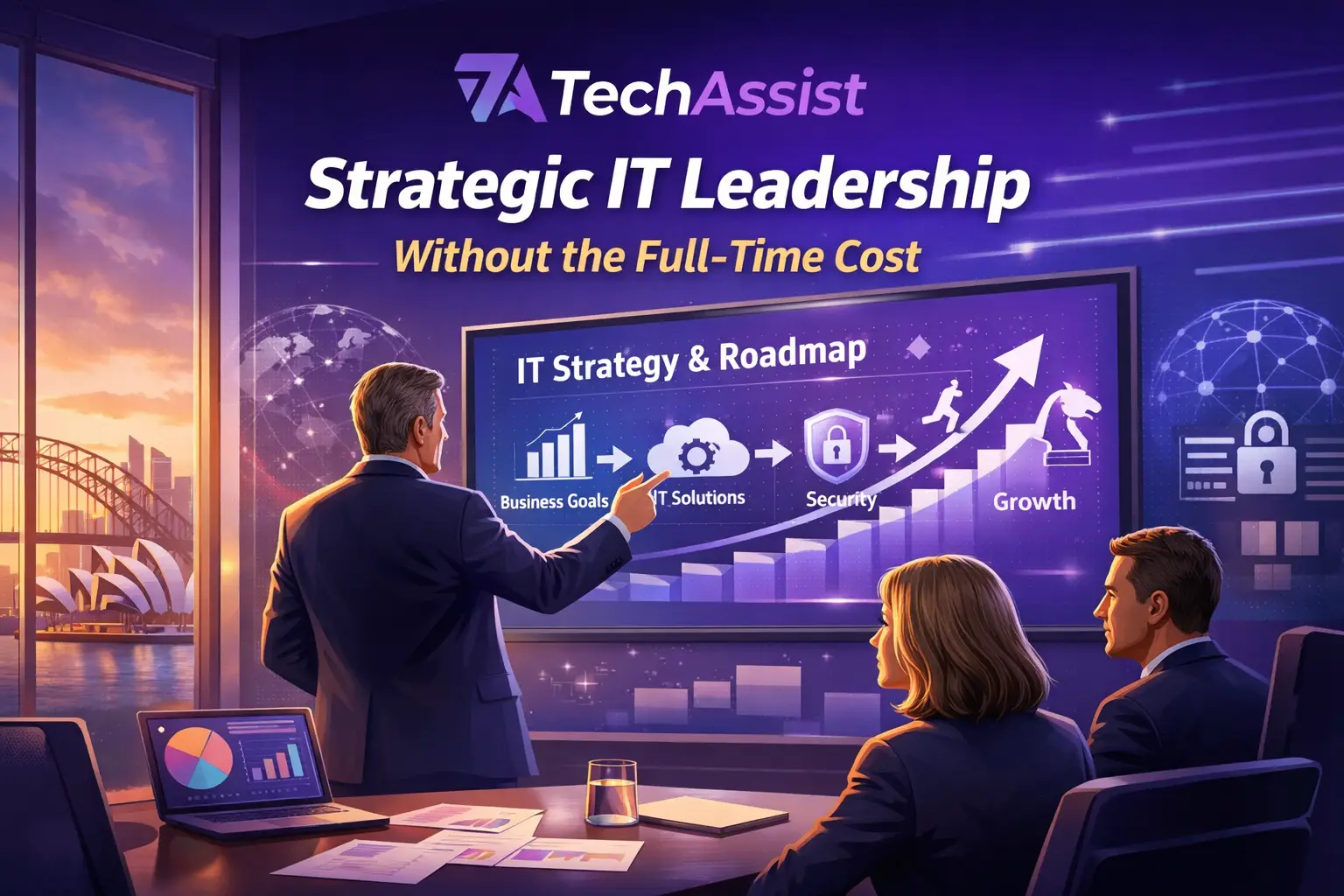
Unlike a standard IT support technician who fixes things when they break, a virtual CIO looks at the bigger picture. They align your technology investments with your business goals, plan your IT roadmap for the next one to three years, manage vendor relationships, oversee cybersecurity strategy, and ensure your infrastructure can scale as your business grows.
Why Australian SMEs Are Turning to vCIO Services
The days of treating IT as a cost centre that just needs to “keep the lights on” are over. Technology decisions now directly impact revenue, customer experience, compliance obligations, and competitive positioning. Yet most businesses with 20 to 200 employees do not have anyone at the leadership table who truly understands technology strategy.
This creates a dangerous gap. Without strategic IT leadership, businesses end up making reactive decisions: buying software because a vendor gave a good demo, renewing contracts without negotiating, running infrastructure that should have been replaced two years ago, or ignoring compliance requirements until an audit forces action.
A virtual CIO fills that gap. They become your trusted technology advisor who understands both the business side and the technical side. They sit in on leadership meetings, contribute to strategic planning, and translate complex IT decisions into plain language that business owners can actually use to make informed choices.
What Does a Virtual CIO Actually Do?
The scope of a vCIO engagement varies depending on your business needs, but typically includes the following responsibilities.
IT Strategy and Roadmap Development
Your vCIO develops a technology roadmap that aligns with your business plan. This is not a generic document: it is a practical plan that identifies what needs to happen, when, and why. It covers infrastructure upgrades, software migrations, cloud adoption, cybersecurity improvements, and budget forecasting. The roadmap gives you visibility into upcoming IT investments so there are no surprises.
Technology Budget Planning
A virtual CIO helps you spend smarter, not necessarily more. They review your current IT expenditure, identify waste (unused licences, redundant tools, overpriced contracts), and build a realistic technology budget that supports your growth plans. Many businesses find that a vCIO actually reduces their overall IT spend by eliminating inefficiencies and negotiating better vendor terms.
Vendor Management
Most SMEs deal with multiple technology vendors: Microsoft 365, internet providers, phone systems, line-of-business applications, security tools, backup providers, and more. Managing these relationships, reviewing contracts, and ensuring you are getting value for money takes time and expertise. Your vCIO takes ownership of vendor relationships, handles contract negotiations, and ensures your vendors are delivering what they promised.
Cybersecurity Governance
With the Essential Eight framework now a baseline expectation for Australian businesses, cybersecurity governance has become a board-level concern. Your vCIO oversees your cybersecurity strategy, ensures you are progressing against the Essential Eight maturity model, reviews incident response plans, and keeps your business ahead of evolving threats. They provide regular security reporting in language that non-technical stakeholders can understand.
Cloud Strategy and Migration Planning
Moving to the cloud is not a simple decision. A virtual CIO evaluates which workloads should move to the cloud, which should stay on-premises, and which need a hybrid approach. They assess providers, plan migration timelines, manage risk, and ensure your team is prepared for the transition. Getting cloud strategy wrong can be expensive, a vCIO helps you get it right the first time.
Compliance and Risk Management
Depending on your industry, you may need to comply with regulations such as the Privacy Act, the Notifiable Data Breaches scheme, PCI DSS, HIPAA (if you deal with US health data), or industry-specific frameworks. Your vCIO ensures your IT environment meets these requirements and can demonstrate compliance when auditors come calling. They also conduct regular IT audits to identify gaps before they become problems.
Virtual CIO vs Full-Time CIO: The Real Comparison
The most obvious difference is cost. A full-time CIO in Australia costs $200,000 to $350,000 per year in total compensation. A virtual CIO service typically runs between $2,000 and $8,000 per month depending on scope and complexity, that is a saving of 70 to 90 percent.
But cost is only part of the equation. A virtual CIO from a managed service provider brings experience across dozens or hundreds of client environments. They have seen what works and what fails across multiple industries, multiple technology stacks, and multiple business sizes. A full-time CIO, no matter how talented, only has the perspective of the organisations they have worked in.
The trade-off is availability. A full-time CIO is in your office every day. A virtual CIO typically engages for a set number of hours per month, perhaps 10 to 40 hours depending on the agreement. For most SMEs, this is more than enough. Strategic IT decisions do not require someone sitting at a desk five days a week. They require focused, expert input at the right times.
Signs Your Business Needs a Virtual CIO
Not every business needs a vCIO immediately, but there are clear indicators that you have outgrown ad-hoc IT decision-making. You likely need a virtual CIO if your business is experiencing any of the following situations.
Your IT spending keeps increasing but you are not sure what you are getting for it. Technology decisions are being made by people who do not have IT expertise. You have no documented IT strategy or technology roadmap. Compliance requirements are increasing and you are not confident you are meeting them. You are planning a major project like a cloud migration, office move, or ERP implementation. Your current IT provider only handles break-fix support with no strategic input. You have been through a cybersecurity incident and realised your defences were inadequate.
If three or more of those resonate, a virtual CIO engagement would likely deliver significant value.
How TechAssist Delivers vCIO Services
At TechAssist, our vCIO service is not a bolt-on afterthought: it is a core part of how we work with clients. Every vCIO engagement starts with a comprehensive assessment of your current IT environment, business goals, and pain points. From there, we develop a tailored technology roadmap and meet with your leadership team on a regular cadence, typically monthly or quarterly, to review progress, adjust priorities, and plan ahead.
Our vCIOs are senior consultants with decades of experience across Australian industries including legal, accounting, manufacturing, construction, mining, and professional services. They are backed by our full technical team, which means when a strategic recommendation needs to be implemented, there is no gap between planning and execution.
We provide quarterly business reviews with clear metrics, annual IT health assessments, budget forecasting, vendor scorecards, and cybersecurity governance reporting. Everything is documented, measurable, and tied back to your business objectives.
Getting Started
If your business is ready for strategic IT leadership without the cost of a full-time executive, a virtual CIO is the practical solution. Contact TechAssist to discuss how a vCIO engagement can transform how your business uses technology, from a reactive cost centre into a genuine competitive advantage.