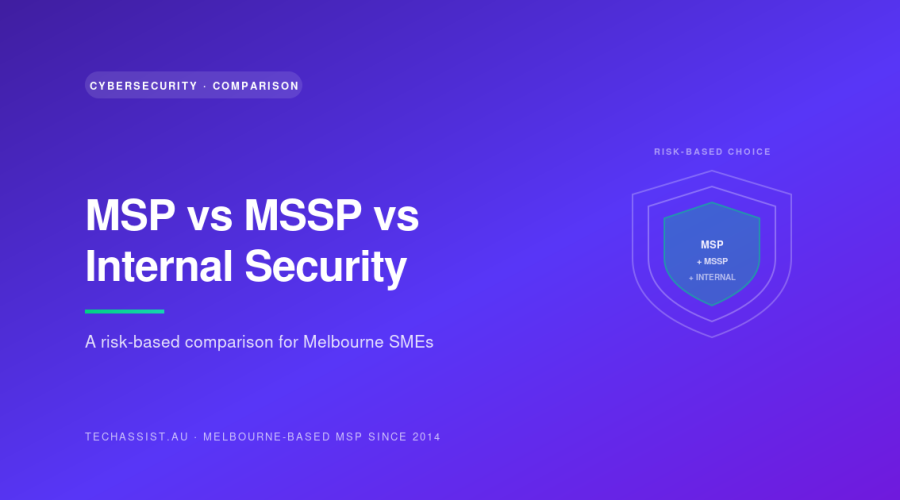
If your Melbourne SME handles routine business data with sensible security baked into IT operations, an MSP is usually the right call. If you’re regulated, a frequent target, or you’ve had an incident, you likely need MSSP-grade detection and response on top. The honest answer for most 50-300 staff businesses sits between.
That middle ground is where most of the confusion lives. The acronyms get used interchangeably by sales teams, the pricing models look superficially similar, and the marketing pages all promise the same outcomes. But the operational reality is very different, and choosing the wrong model leaves you either overpaying for capability you can’t consume, or underprotected against threats your provider was never set up to catch.
This post compares the three operating models, MSP, MSSP, and internal security team, through the lens of risk profile rather than feature list. If you’ve already read our cost comparison between managed security and an in-house team, this is the companion piece: same decision, different angle.
What each model actually does in practice
Before we get to the comparison, it’s worth being concrete about what these labels mean on the ground in 2026, because the definitions have drifted.
MSP (Managed Service Provider)
An MSP runs your IT. That covers user onboarding and offboarding, endpoint management, Microsoft 365 administration, server and network operations, backup, patching, vendor liaison, and the help desk your staff ring when their laptop won’t connect to the printer. A modern MSP also runs a competent security baseline as part of that work, and this is the part most decision-makers misunderstand. A capable Australian MSP in 2026 should be delivering, as standard:
- MFA enforcement across all identity surfaces, with conditional access policies tuned to your risk
- EDR (endpoint detection and response) deployed and managed on every endpoint
- Patch management on a defined cadence, with exception reporting
- Backup with immutable copies and tested restore procedures
- Email security with sandboxing and impersonation protection
- Alignment to the Essential Eight at a documented maturity level
- Quarterly security reviews and a documented risk register
That’s not a security service in the MSSP sense: it’s hygiene. But it’s the hygiene that prevents most incidents. The Australian Cyber Security Centre’s annual reporting consistently shows that the bulk of compromises against SMEs come through gaps in exactly these controls, not through sophisticated targeted attacks.
MSSP (Managed Security Service Provider)
An MSSP doesn’t run your IT. It runs your detection and response capability. The core deliverables look like this:
- 24/7 Security Operations Centre (SOC) staffed by analysts whose entire job is watching alerts
- SIEM (security information and event management): ingesting logs from your endpoints, identity, network, cloud, and SaaS, and correlating them in real time
- MDR (managed detection and response): active threat hunting and containment, not just alerting
- Vulnerability management as an ongoing programme with prioritised remediation
- Incident response with defined containment playbooks and a retainer for serious events
- Threat intelligence specific to your sector and geography
- Compliance reporting against frameworks like ISO 27001, SOC 2, APRA CPS 234, or the Privacy Act
That’s a different operation entirely. The skill set is different (security analysts, not generalist engineers), the tooling is different (SIEM platforms cost serious money before you’ve hired anyone), and the operating model is different (event-driven, 24/7, with measured time-to-detect and time-to-contain).
Internal security team
An internal security team is exactly what it sounds like, people on your payroll who own security as their job. In Australian SME context, the entry point is usually a single security manager or CISO-equivalent, supported by IT staff who pick up some security work. A proper internal capability that can actually detect and respond to incidents needs at minimum three to four people to cover a 24/7 roster, plus tooling, and at that point you’re looking at $700k-$900k a year in salary and licences before you’ve turned the lights on.
The comparison by risk profile
The right model depends on your risk profile, not your headcount. A 60-person law firm dealing with sensitive client matters has a different threat picture to a 250-person manufacturer making widgets. Here’s how the three models map against typical Melbourne SME risk profiles.
| Factor | MSP with security baseline | MSSP (specialist) | Internal security team |
|---|---|---|---|
| Risk profile suited | Low to moderate: standard business data, no specific regulatory obligation, no history of targeted attacks | Moderate to high: regulated industry, holds large volumes of PII or financial data, known threat target, prior incident | High: large enterprise risk profile, sovereign data obligations, board-level security oversight required |
| Capability depth | Broad: generalist engineers covering IT operations with security hygiene built in | Deep but narrow: specialists in detection, response, threat hunting; doesn’t touch general IT | Whatever you can hire: usually narrow until you can afford 5+ FTEs |
| Coverage hours | Business hours with after-hours P1 escalation; NOC monitoring of infrastructure 24/7 | 24/7 SOC with named analysts on shift | Whatever your roster supports: rarely true 24/7 below 4 FTEs |
| Realistic annual cost (100 staff) | $120k-$220k all-in for managed IT including security baseline | $80k-$180k for MSSP services on top of IT | $400k-$900k for a credible team plus tooling |
| Time to value | 30-60 days for full onboarding | 60-120 days to ingest logs, tune SIEM, build runbooks | 6-18 months to recruit, onboard, and reach operational maturity |
| Best fit business size | 20-300 staff with standard risk profile | 50+ staff with elevated risk, or any size with regulatory obligation | 500+ staff, or smaller with board mandate and budget |
How to read your own risk profile honestly
The question isn’t “are we at risk”: every business is. The question is what kind of risk, and what level of capability that justifies. A few practical tests we use when scoping work for new clients:
What’s the data you actually hold? A 120-staff accounting firm holding trust account data, ATO records, and personal financial information for several thousand clients has materially different exposure to a 120-staff industrial supplier. The former is a high-value target with legal obligations; the latter mostly needs to not be the easiest door on the street. We’ve written separately about accounting firm data security and trust account protection because that sector’s risk profile is genuinely different.
What’s your regulatory exposure? If you’re subject to APRA CPS 234, the Privacy Act notifiable breach scheme with material consequences, ISO 27001 certification for tendering, SOC 2 for SaaS customers, or sector-specific obligations (healthcare, legal, financial services), you need defensible detection and response. An MSP security baseline won’t pass that audit. You need MSSP-grade logging, retention, and incident handling.
Have you been hit before? Past incidents are the strongest predictor of future ones. If you’ve had a serious phishing-led compromise, a business email compromise event, or a near-miss with ransomware, your risk profile has changed. Threat actors share target lists. Going back to baseline hygiene after an incident is rarely sufficient.
What’s the impact of 72 hours of downtime? If a ransomware event would cost you tens of millions in lost revenue, contractual penalties, or customer churn, the maths on MSSP coverage gets simple very quickly. If three days of disruption would be painful but survivable, you can probably tolerate the slightly longer response curve of MSP-managed security with on-call escalation.
A concrete example: 120-staff CBD financial services firm
To make this less abstract: we onboarded a financial planning firm in the Melbourne CBD last year, about 120 staff across two offices, holding personal financial data and SOA documentation for around 4,000 clients. They came to us convinced they needed a full MSSP engagement because their incumbent IT provider had been quietly running on autopilot for years and they’d had a phishing scare.
What they actually needed was different. Their immediate exposure was the hygiene gap: MFA was inconsistent, EDR was deployed but never reviewed, patch cadence had slipped, and there was no documented backup test in the previous twelve months. We spent the first 90 days closing that gap as part of standard managed IT work, and aligned them to Essential Eight Maturity Level Two.
Six months in, with the baseline solid, we added managed SOC services through our Tecoma facility: SIEM ingestion of their identity, endpoint, and Microsoft 365 logs, 24/7 monitoring, and a defined incident response runbook. Total annual spend ended up roughly $190k for managed IT plus $95k for the SOC overlay. A full MSSP-only engagement would have cost similar money but left their underlying IT untouched, which was the actual source of risk.
That’s the pattern we see most often. The MSP-versus-MSSP framing is usually a false choice. What most Melbourne SMEs need is a strong MSP foundation with security overlays added where the risk justifies them.
Where the hybrid model fits
The integrated approach, MSP with embedded or overlaid SOC services, is increasingly common among Australian providers, and for good reason. The handoff problem between an MSP and a separate MSSP is real: when a SIEM alert fires at 2am, who patches the server, who isolates the endpoint, who talks to the client? Two providers means two contracts, two sets of runbooks, and a coordination gap right at the worst moment.
TechAssist runs an integrated model out of our Tecoma facility. The NOC with 24/7 on-call and emergency support handles infrastructure monitoring and the managed SOC services overlay handles security event detection and response, with the same engineering team handling containment and remediation. 15-minute average response on P1 events. Essential Eight aligned by default. 13 Melbourne-employed staff, no offshore tier-one. We’ve been operating this model since 2014 and the integration matters, it’s the difference between a fast alert and a fast response.
This isn’t the right answer for every business. If you’re a 500-staff financial services firm with mature internal IT and you need to overlay specialist detection, a pure MSSP engagement on top of your existing team makes sense. If you’re a 60-staff professional services firm where IT is one person plus a help desk, the integrated MSP-plus-SOC model is usually a better fit than trying to manage two providers.
The decision framework
If you take nothing else from this post, work through these questions in order:
- What’s our current security maturity? If you don’t have MFA universally enforced, EDR managed and reviewed, current patching, tested backups, and Essential Eight alignment, that’s where to start. No amount of SOC monitoring compensates for missing baseline. This is MSP territory: see our managed IT services page for what that scope looks like.
- What’s our regulatory and contractual exposure? If audits, certifications, or customer contracts require defensible detection and response, you need MSSP-grade capability. Document the specific clauses driving this: it sharpens the conversation.
- What’s the business impact of a serious incident? Run the numbers honestly. Lost revenue per day of downtime, customer churn, contractual penalties, regulatory fines, remediation costs, reputational damage. If that number is significant relative to your annual revenue, the maths on 24/7 SOC coverage works.
- Do we have the internal capacity to consume security services? An MSSP that ships you a hundred alerts a week is worthless if nobody on your side reads them. You need either an internal point of contact or an MSP partner who can act on the alerts. Our managed cyber security services are designed around this: SIEM, MDR, and EDR delivered as a managed service so you’re not drowning in alerts.
- What’s our growth trajectory? A 100-staff business heading to 250 over two years has different needs to one that’s stable. Build the operating model for where you’ll be, not where you are.
Cost reality check
The pricing in the comparison table reflects what we see in the Australian market in 2026, but ranges hide a lot. A few honest observations on cost.
MSP pricing in Melbourne for 100 staff is genuinely competitive, the market has matured and rates have compressed. $120k-$220k a year all-in is realistic for managed IT with a good security baseline. If you’re paying less, check what’s missing (almost always EDR management, backup testing, or genuine 24/7 escalation). If you’re paying significantly more, check what you’re getting that justifies it.
MSSP pricing is harder to benchmark because the deliverables vary wildly. Some “MSSP” offerings are essentially log forwarding with email alerts and a pretty dashboard, at $40k a year, you get what you pay for. Genuine 24/7 SOC with named analysts, MDR, and incident response retainer runs $80k-$180k for a 100-staff environment. The gap between cheap and credible MSSP is bigger than the gap between cheap and credible MSP.
Internal teams remain expensive. The economics only work at scale or when you have specific reasons (sovereign data, board mandate, M&A history that built a team) that make outsourcing untenable. For most Melbourne SMEs in the 50-300 staff range, the build-versus-buy maths favours managed services by a wide margin. We’ve gone deeper on this in the co-managed versus managed versus internal IT comparison.
What good looks like
A useful test when you’re evaluating any provider, MSP, MSSP, or hybrid, is to ask specific questions and listen for specific answers:
- What’s your time-to-detect and time-to-contain on a typical credential compromise event? (Vague answers are a red flag.)
- How do you ingest and retain logs, and what’s the retention period?
- What’s your incident response runbook? Walk me through the first hour of a ransomware event.
- What’s your Essential Eight maturity assessment for your own operations?
- Who’s on shift at 3am on a Sunday, and what’s their authority to act?
- What’s your escalation path to my team, and at what point do you involve us?
- Can I see a sanitised incident report from a real event you’ve handled?
Providers who can answer these crisply have operational maturity. Providers who deflect or speak only in marketing language don’t. This applies equally to MSPs claiming security capability and MSSPs claiming SOC depth.
Frequently asked questions
What’s an MSSP and how is it different from an MSP?
An MSP (Managed Service Provider) runs your IT operations, endpoints, identity, infrastructure, help desk, backup, and patching, with a security baseline built in. An MSSP (Managed Security Service Provider) is specialised in security detection and response: 24/7 SOC, SIEM operations, threat hunting, incident response, and vulnerability management. The MSP keeps the lights on; the MSSP watches the perimeter and inside the network for active threats.
Do we need both an MSP and an MSSP?
Most Melbourne SMEs in the 50-300 staff range don’t need two separate providers. The two common solutions are either an MSP with a strong managed security baseline (suitable for standard risk profiles) or an integrated provider offering both MSP and managed SOC services from one operations centre. Running two separate providers introduces coordination problems during incidents, which is exactly when coordination matters most. The exception is larger or highly regulated businesses where deep MSSP specialisation justifies the handoff complexity.
What does an MSSP cost in Australia?
For a 100-staff Australian SME, credible MSSP services run $80k-$180k per year on top of existing IT spend. That covers 24/7 SOC monitoring, SIEM ingestion across endpoints and identity, MDR, vulnerability management, and incident response retainer. Cheaper offerings exist but usually reduce to log forwarding with email alerts, not the same thing. Pricing scales with log volume, endpoint count, and the breadth of sources ingested (cloud, SaaS, network, identity, endpoint).
When is an internal security team the right answer?
An internal team makes sense when you’re at 500+ staff, have specific sovereign data or regulatory obligations that prevent outsourcing, have board-level mandate for in-house capability, or have inherited a team through acquisition. Below that, the economics rarely work, a credible 24/7 internal capability costs $700k-$900k a year before tooling, and Australian security talent is in short supply. Most SMEs are better served by managed services and selectively building internal capability (typically a security manager or CISO) on top.
How do we know if our current MSP is doing enough on security?
A few quick tests. Ask for evidence of: MFA enforcement across all users with conditional access policies, EDR deployed and actively managed with monthly reviews, current patch status report, last successful backup restore test (within 90 days), Essential Eight maturity assessment, and quarterly security review meetings. If your provider can’t produce this evidence within a week, security is not being actively managed regardless of what your contract says.
Where to start
If you’re trying to work out which model fits your business, the most useful first step is an honest assessment of where you are now: current controls, current gaps, current risk profile, and current regulatory exposure. From there the right operating model becomes clearer. We do this assessment as part of scoping for new clients, and it doesn’t commit you to anything.
Have a look at our cybersecurity services overview for the broader picture of what we cover, or get in touch if you’d rather have a direct conversation. Phone 1300 028 324: we’ll tell you straight whether you need MSP, MSSP, the hybrid, or none of the above.