The Security Staffing Dilemma for Australian SMEs
Every Australian business needs cybersecurity. The question isn’t whether to invest in security: it’s how. Do you hire an in-house security specialist, build a team internally, or outsource to a managed security services provider (MSSP)? For most SMEs with 20 to 200 staff, the answer isn’t as obvious as it might seem.
Cyber attacks on Australian businesses are increasing every year. The ACSC reports that a cybercrime is reported every six minutes, and SMEs are increasingly the primary target because criminals know they typically have weaker defences than large enterprises. But building effective cybersecurity isn’t just about buying software: it’s about having the right people, processes, and technology working together around the clock.
The True Cost of In-House IT Security
Let’s start with the numbers that most business owners don’t fully account for when considering in-house security.
Staff Costs
A qualified cybersecurity analyst in Australia commands a salary of $90,000 to $140,000 depending on experience and location. A senior security engineer or security architect sits at $140,000 to $200,000+. Add superannuation (11.5%), workers compensation, training, and benefits, and your actual cost is 20-30% above the base salary.
But here’s the problem: cybersecurity isn’t a 9-to-5 job. Threats don’t stop at 5pm on a Friday. If you want genuine 24/7 coverage, you need a minimum of three to four full-time security staff to cover shifts, leave, and sick days. That’s $400,000 to $600,000 per year in staffing alone, before you’ve bought a single tool.
Technology Costs
Professional security tools aren’t cheap. Enterprise-grade SIEM (Security Information and Event Management) platforms cost $30,000 to $100,000+ annually. Endpoint detection and response (EDR) tools like SentinelOne or CrowdStrike run $30 to $60 per endpoint per month. Add vulnerability scanning, email security, firewall management, threat intelligence feeds, and security awareness training platforms, and you’re looking at $50,000 to $150,000 per year in tooling for a mid-sized business.
The Hidden Costs
Beyond salaries and tools, in-house security carries hidden costs that are easy to overlook: recruitment costs (finding good security people is notoriously difficult in Australia’s tight talent market), ongoing training and certification (security professionals need constant upskilling), staff turnover (the average tenure for a cybersecurity professional in Australia is just 2.5 years), and the opportunity cost of your management time spent overseeing a security function that isn’t your core business.
The Managed Security Services Model
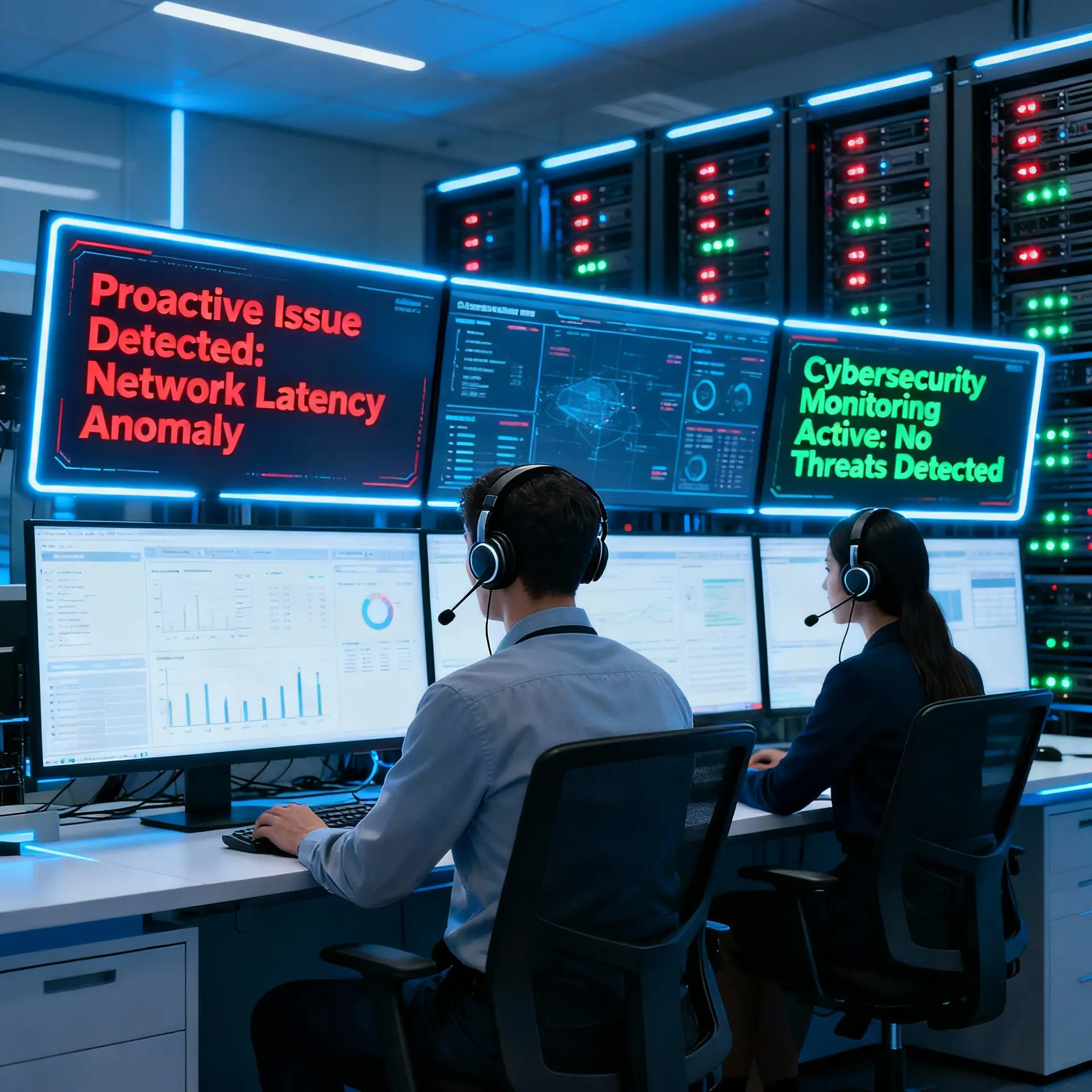
A managed security services provider handles your cybersecurity on an outsourced basis. The scope varies by provider, but a comprehensive MSSP engagement typically includes 24/7 security monitoring and alerting, endpoint protection deployment and management, email security and phishing prevention, vulnerability management and patching, incident response, compliance management (Essential Eight, ISO 27001), security awareness training, and regular security assessments.
What Does Managed Security Cost?
For an Australian SME with 50 to 100 users, comprehensive managed security services typically cost between $3,000 and $8,000 per month: or $36,000 to $96,000 per year. That includes the technology stack, the monitoring, the expertise, and the 24/7 coverage. Compare that to the $500,000+ you’d spend building the same capability in-house, and the value proposition becomes clear.
When In-House Security Makes Sense
In-house security isn’t always the wrong choice. It can make sense if you’re a larger organisation (200+ staff) with the budget to build a proper security operations centre, you’re in a heavily regulated industry where direct control over security operations is required, you handle classified or government-sensitive data with specific personnel security clearance requirements, or you have unique security needs that require deep, continuous internal knowledge.
For most Australian SMEs, however, none of these conditions apply.
When Managed Security Makes Sense
Managed security is typically the better choice when you have fewer than 200 staff and can’t justify a dedicated security team, you need 24/7 monitoring but can’t staff it internally, you want access to enterprise-grade security tools at a fraction of the standalone cost, you need to meet compliance requirements (Essential Eight, ISO 27001, PCI DSS) but lack in-house expertise, or you want predictable monthly security costs rather than unpredictable capital expenditure.
The Hybrid Approach
Many businesses find that the best approach is a hybrid model: one or two internal IT staff who understand the business and handle day-to-day operations, supported by an MSSP that provides the specialised security expertise, 24/7 monitoring, and advanced tooling. This gives you the best of both worlds, internal knowledge and responsiveness, plus external depth and round-the-clock coverage.
Making the Right Choice for Your Business
The decision between in-house and managed security shouldn’t be based on pride or preference: it should be based on math, risk appetite, and capability. Ask yourself: can we genuinely provide 24/7 security coverage with our current team? Do we have the budget to hire, train, and retain qualified security professionals? Are we confident our security posture meets the compliance requirements our clients and regulators expect?
If the answer to any of those questions is no, it’s worth having a conversation with a managed security provider.
Learn more about TechAssist’s managed security services or contact us for a no-obligation security assessment.
Related If the in-house vs managed cyber math leans toward managed, see our managed cybersecurity for Melbourne businesses, flat monthly fee, full team, Essential Eight aligned.