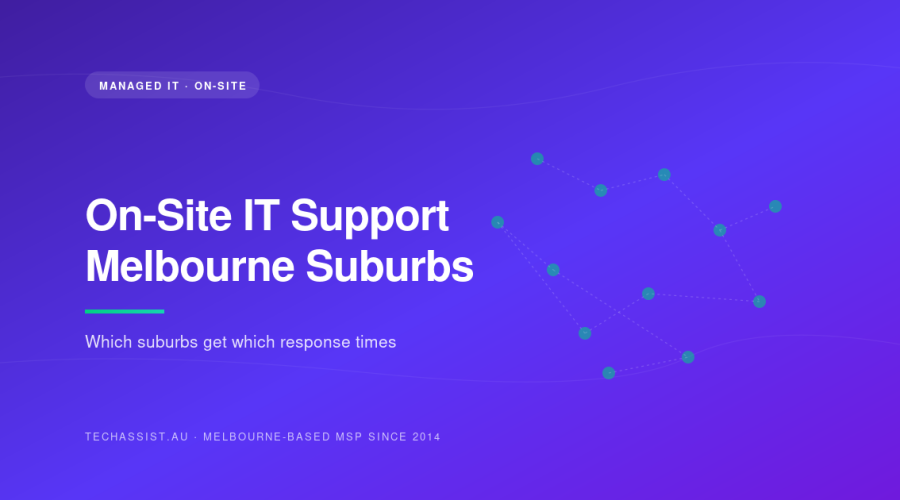
If you need an engineer physically standing in your server room or next to a user’s desk, the honest answer depends on which suburb you’re in. For most of Melbourne metro we’ll be on-site same business day, and for inner-CBD and inner-east clients we’re usually there within two hours of a P1 call.
This post lays out the actual numbers, suburb by suburb, rather than the usual “we cover all of Melbourne” line that every MSP website carries.
Why suburb-level honesty matters
Every Melbourne MSP claims metro coverage. Most of them operate from a single office, usually somewhere in the inner east or the CBD fringe. That’s fine if you’re in Richmond or South Yarra. It’s a problem if your warehouse is in Dandenong South, your shopfront is in Werribee, and your head office is in Hawthorn, because the same engineer can’t realistically reach all three in a day from a single base.
For on-site IT support Melbourne wide, response time is a function of three things: where your engineer starts the day, how Melbourne’s traffic behaves at the time you call, and how many other tickets are already in the queue ahead of you. The first one is the only variable an MSP actually controls, and it’s the one that gets glossed over in sales conversations.
TechAssist runs two offices on purpose. Our main workshop is in Tecoma in the Dandenong Ranges foothills, which puts us inside the east and outer-east catchment. Our second office is at 575 Bourke Street in the CBD, which covers the city, inner north, inner west and bayside. With 13 Melbourne-employed staff split across the two, we can actually answer the question “how fast can you get to my suburb?” with a real number instead of a marketing platitude.
The two-office model, briefly
We’ve written about the reasoning behind inner Melbourne versus outer-east MSP office location in a separate post, that one is about the strategic call. This one is about the operational consequence: where each office gets to first, and how the two catchments overlap.
Quick summary of the geography:
- Tecoma office: sits on the Burwood Highway / Belgrave train line corridor. Natural catchment runs from Box Hill out through Ringwood, Croydon, Lilydale, Mooroolbark, Mount Evelyn, Wonga Park, the Dandenongs themselves and the Yarra Valley. Also covers the south-east through Glen Waverley, Mulgrave and Dandenong with reasonable times.
- 575 Bourke Street office: sits in the legal/finance precinct of the CBD. Natural catchment runs through the CBD itself, Docklands, Southbank, South Melbourne, Port Melbourne, then inner north (Carlton, Brunswick, Northcote), inner west (Footscray, Yarraville, Williamstown), inner east (Richmond, Hawthorn, Camberwell) and bayside (St Kilda, Brighton, Sandringham).
The two catchments overlap heavily through the inner east. Camberwell, Hawthorn and Kew can be served quickly from either office depending on traffic and who’s free. That overlap is deliberate. It’s also where most of our managed services clients are concentrated, so it tends to be the busiest patch.
Response-time table by suburb cluster
The table below shows realistic same-business-day arrival times for a P1 (production-down) ticket logged before 3pm on a normal weekday. Times assume the closer office has an engineer available, which is the case roughly 90% of the time given the team size. P2 and P3 tickets follow the same routing but are scheduled rather than rushed.
| Cluster | Example suburbs | Primary office | Target on-site (P1) | Standard on-site (P2/P3) |
|---|---|---|---|---|
| Inner CBD | Melbourne CBD, Docklands, Southbank, East Melbourne | 575 Bourke St | Under 60 minutes | Same business day |
| Inner east | Richmond, Hawthorn, Kew, Camberwell, Balwyn | Either | Under 90 minutes | Same business day |
| Outer east | Box Hill, Blackburn, Ringwood, Croydon, Mitcham | Tecoma | Under 90 minutes | Same business day |
| South-east | Glen Waverley, Mulgrave, Dandenong, Rowville, Wheelers Hill | Tecoma | 90 to 120 minutes | Same business day |
| Bayside | St Kilda, Brighton, Sandringham, Hampton, Elwood | 575 Bourke St | 90 to 120 minutes | Same business day |
| Inner north | Carlton, Brunswick, Northcote, Fitzroy, Collingwood | 575 Bourke St | Under 90 minutes | Same business day |
| Inner west | Footscray, Yarraville, Seddon, Williamstown, Kensington | 575 Bourke St | Under 90 minutes | Same business day |
| Outer west | Sunshine, Werribee, Point Cook, Tarneit, Hoppers Crossing | 575 Bourke St | 2 to 3 hours | Same business day (booked) |
| Yarra Valley / foothills | Lilydale, Mooroolbark, Wonga Park, Healesville, Yarra Glen | Tecoma | Under 60 minutes | Same business day |
| Dandenong Ranges | Belgrave, Upwey, Tecoma, Sherbrooke, Olinda | Tecoma | Under 30 minutes | Same business day |
| Bayside south-east | Mentone, Cheltenham, Mordialloc, Parkdale | Either | 2 hours | Same business day |
| Far north | Bundoora, Greensborough, Eltham, Diamond Creek | Tecoma (via Eastlink) | 2 to 3 hours | Same business day (booked) |
A few things worth calling out:
- P1 response averages 15 minutes; that’s the time to a human engineer on the phone or remote session, not the on-site arrival. The table above is specifically about feet-on-the-ground times once we’ve established remote work won’t fix it.
- About 70% of what gets logged as “needs on-site” turns out to be solvable remotely once an engineer actually looks at it. The on-site numbers above are for the genuine remainder.
- Traffic in Melbourne is what it is. Burnley Tunnel between 7:30am and 9am, Monash between 4pm and 6:30pm, Westgate basically any peak, these can push the headline numbers out by 30 to 45 minutes. We dispatch from whichever office has the better run at the time.
A concrete example: multi-site retailer
Last year a homewares retailer with six shops came to us after their previous MSP, a single-office shop based in Mount Waverley, kept missing on-site SLAs on the western stores. Their footprint:
- Head office and warehouse in Box Hill
- Flagship in the CBD (Bourke St Mall)
- Shopfronts in Doncaster, Chadstone, Highpoint (Maribyrnong) and Werribee Plaza
The previous arrangement had every on-site call dispatched from Mount Waverley. Box Hill, Doncaster and Chadstone were fine. The CBD store got served eventually. Highpoint and Werribee routinely waited four to six hours, because the same engineer had to clear the eastern tickets first and then drive across town in afternoon traffic.
We took it on under a split-routing model: Box Hill, Doncaster and Chadstone get served from Tecoma. The CBD, Highpoint and Werribee get served from 575 Bourke Street. The Werribee store, which used to be a six-hour wait, now sees an engineer inside two and a half hours. Highpoint is usually under 90 minutes. None of it required us to hire extra staff, just to dispatch from the office that was actually closer.
This is the kind of thing that doesn’t show up in a tender response, but it matters a lot once you’re three months into a contract and your Werribee store manager is calling head office for the fourth time that week.
Where we’re slower: and why we’ll tell you
There are parts of Melbourne metro where we are not the fastest option. We’d rather be upfront about it:
- Frankston / Mornington Peninsula: we cover this for existing clients who have a head office inside our normal catchment and a satellite site down south. We don’t take on standalone Frankston-only clients because we can’t promise sub-three-hour on-site, and there are good local MSPs who can.
- Outer north (Craigieburn, Mickleham, Wollert): covered, but expect two to three hours on-site rather than 90 minutes. Same applies to Sunbury and Diggers Rest.
- Geelong and the Bellarine, not in scope. We have clients with Geelong branches that we service via remote-first plus pre-booked monthly site visits, but it’s not a P1-response area for us.
- Bendigo, Ballarat, Latrobe Valley: same as Geelong. Project work and managed services yes, urgent on-site response no.
That’s a list of about a dozen postcodes out of the hundreds we cover. The vast majority of Melbourne metro, and certainly the postcodes where most SMEs sit, falls inside the same-business-day window.
What “same business day on-site” actually requires
The reason most MSPs can’t honestly commit to same-business-day on-site across all of Melbourne metro comes down to maths, not effort. To consistently hit it you need:
- Enough engineers, if you have three field techs covering 200 clients across 50 suburbs, you’re going to miss. We run 13 Melbourne-employed staff (most of whom do both remote and on-site work) split between the two offices, which keeps the load per engineer reasonable.
- Geographic spread of those engineers: one engineer who lives in Berwick, another in Footscray, another in Eltham, and so on. We deliberately hire across the metro rather than concentrating in one area, because home-base proximity matters for early-morning P1s.
- A dispatch process that actually looks at the map, not “next available” but “next available who’s closest to the site”. This sounds obvious but plenty of helpdesks still dispatch on availability alone.
- Two physical bases, so that morning starts and stockpiled spares don’t all originate from the same postcode.
We’ve had the two-office model in place since the Bourke Street office opened. Before that we were Tecoma-only, founded in 2014, and we genuinely couldn’t make the same response promises for the western suburbs that we make now.
How the dispatch decision actually gets made
When a P1 ticket comes in, the dispatcher looks at three things in order:
- Postcode of the site (which office is geographically closer)
- Current location of available engineers (one of them may already be near the site for another job)
- Time of day (a 4pm Westgate Bridge run from the CBD to Werribee is worse than a 4pm Tecoma-to-Glen Waverley run, even though the latter is technically further)
It’s not complicated, but it does require the dispatcher to know Melbourne. Our service desk team is all based in Australia: that’s not an idle boast, it’s a functional requirement, because someone in Manila isn’t going to know that the Burnley Tunnel just shut and the Eastern is the better call.
Where this fits with remote support
This post is about on-site response specifically. The broader question of when on-site is the right answer at all is covered in our piece on remote IT helpdesk versus on-site support, short version: most issues should and do get fixed remotely, and the value of on-site is that it’s there for the issues that genuinely need hands-on work.
What’s worth saying here is that fast on-site coverage doesn’t make remote support less important. The two work together. A good MSP triages remotely, fixes what it can remotely, and dispatches an engineer only when a remote fix isn’t viable. The on-site response time matters precisely because by the time we’re driving to your office, we’ve already established the issue can’t be resolved any other way.
What we cover in each direction
If you want a more detailed look at how we handle the eastern suburbs in particular, which is where the bulk of our outer-metro client base sits, we’ve written that up separately under IT support eastern suburbs. The general overview of our delivery model is under on-site technical support and the broader managed services context is under managed IT services Melbourne.
For the office locations themselves: Melbourne (575 Bourke Street) office, Tecoma office, and the full list of locations with maps and hours.
FAQ
Do you cover regional Victoria?
For existing managed services clients with regional branches, Bendigo, Ballarat, Geelong, Albury, Shepparton, yes, on a planned-visit basis combined with remote-first daily support. For standalone regional businesses where the head office and the only site is regional, we generally won’t be the best fit, because we can’t promise same-day on-site at the prices that work in those markets. Happy to refer you to MSPs we trust in those areas.
What about the Mornington Peninsula?
Covered on a planned basis for clients whose primary site is within our normal metro catchment. Mount Eliza and Mornington itself we can usually reach in around 90 minutes from 575 Bourke Street; Rosebud and the southern peninsula will be closer to two hours. We don’t actively target Peninsula-only businesses because the response times don’t compare favourably with local MSPs based in Frankston or Mornington.
Do you offer after-hours on-site?
Yes, for clients on a managed services agreement that includes after-hours coverage. The on-site response window outside business hours is longer, typically two to four hours rather than the daytime targets above, because we’re calling out an on-call engineer rather than dispatching from a staffed office. P1 phone and remote support is 24/7 for all managed services clients.
What’s the difference in response time between a P1 and a P2?
P1 means production is down: a server has fallen over, the internet is out, no one can log in, an attack is in progress. P1 phone response is under 15 minutes, on-site is per the table above. P2 means a meaningful problem but the business is still running: one user can’t print, a non-critical system is slow, a backup didn’t run. P2 on-site is same business day but scheduled around other work rather than rushed.
Can I get a faster response by paying for a premium SLA?
The targets above are what we deliver under standard managed services agreements. For clients with unusually high uptime requirements, typically those with revenue tied directly to a single point of failure, we’ll sometimes agree custom SLAs that include on-site standby arrangements. Those are uncommon and we’ll only quote them honestly when we can actually deliver, which usually means the client’s site is close to one of our two offices.
A reasonable next step
If you want to know specifically what we can promise for your suburb, or your collection of suburbs across head office and branches, the easiest thing is to send through the postcodes. We’ll come back with the realistic on-site numbers from each of our two offices and tell you straight if we’re not the right fit. Reach us via the contact page or call 1300 028 324. We’re also listed under our main IT support Melbourne page for general enquiries.
The fundamental question: “how fast can you actually be here?”, deserves a specific answer, not a vague metro-coverage claim. The table above is ours.